Double Wall Paper Cups: B2B Engineering, Coatings & Sourcing Guide
Sep 02, 2026In today’s commercial food service and specialty coffee landscapes, single-use drinkware is no longer viewed merely as a recurring consumable line item. Instead, it serves as an indispensable physical touchpoint that dictates beverage temperature preservation, consumer tactile comfort, branding longevity, and regulatory environmental compliance. While the historical default for hot beverage service relied on single wall paper cups paired with external corrugated sleeves, global quick-service restaurant (QSR) chains and beverage distributors are aggressively shifting toward precision-manufactured double wall paper cups produced by specialized manufacturers like Elements Packaging.
This architectural migration is fueled by both physical performance and enterprise unit economics. The friction of warehousing, unboxing, and manually assembling paper sleeves during peak barista workflow creates notable labor constraints and throughput bottlenecks. Concurrently, tightening packaging regulations across North America and Europe—such as the European Union Single-Use Plastics Directive (SUPD) and expanding per- and polyfluoroalkyl substances (PFAS) restrictions—compel procurement teams to thoroughly assess substrate board grammage, liner chemistry, and circular lifecycle economics before committing to multi-container purchase contracts.
This engineering-driven sourcing manual provides commercial buyers, product packaging engineers, and wholesale importers with a comprehensive assessment of thermal air barrier physics, a comparative matrix of lining polymer chemistries (conventional PE versus plant-based PLA versus repulpable aqueous coatings), realistic Total Cost of Ownership (TCO) models, and critical quality control parameters engineered into production lines at Elements Packaging.
To understand the mechanical superiority of an engineered double wall cup, one must evaluate heat transfer dynamics across conductive, convective, and radiative channels. In a standard single wall cup, hot liquids poured at temperatures between 85°C and 93°C (185°F - 200°F) establish an instantaneous conductive thermal pathway directly across the single layer of cellulose paperboard. Because wood pulp paper possesses a thermal conductivity coefficient (κ) of roughly 0.05 to 0.08 W/(m·K), thermal energy penetrates the wall within 3 to 5 seconds, causing outer surface temperatures to quickly breach the human dermal pain threshold of 48°C to 50°C (118°F - 122°F).
A double wall cup completely arrests this rapid conduction path by nesting an inner paper cup inside an outer wrapped sleeve, creating a calibrated dead-air pocket between 0.5 mm and 1.5 mm wide. Dry, stagnant air is one of the most effective natural thermal insulators, demonstrating a very low thermal conductivity of approximately 0.026 W/(m·K). Because this enclosed clearance is engineered to stay below the critical Rayleigh number threshold, internal natural air convection is suppressed. The technical outcomes include:
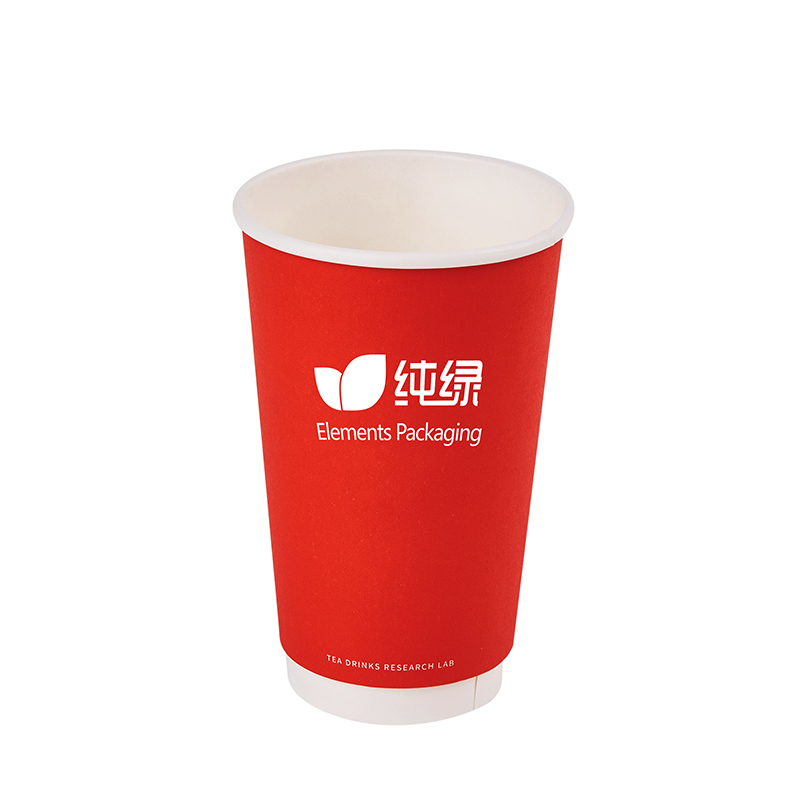
A frequent complaint from drive-thru operators is cup buckling—where a customer grips the cup body and the sidewall collapses inward, dislodging the lid and spilling boiling liquid. Structural rigidity is determined by the combined basis weight (measured in grams per square meter, or GSM) of the primary virgin board and outer wrap. Below is the industrial standard engineering matrix utilized in commercial-grade manufacturing at Elements Packaging:
| Cup Size | Inner Layer Baseboard | Outer Sleeve Board | Total Grammage | Radial Force Tolerance |
|---|---|---|---|---|
| 8 oz (240 ml) | 260 gsm + 18g coating | 250 gsm Virgin Kraft/White | ~528 gsm | < 3.0 mm deflection @ 15 N |
| 12 oz (350 ml) | 280 gsm + 18g coating | 280 gsm Virgin Kraft/White | ~578 gsm | < 3.2 mm deflection @ 18 N |
| 16 oz (480 ml) | 300 gsm + 20g coating | 300 gsm Virgin Kraft/White | ~620 gsm | < 3.5 mm deflection @ 20 N |
| 20 oz / 22 oz (650 ml) | 320 gsm + 20g coating | 320 gsm Virgin Kraft/White | ~660 gsm | < 3.8 mm deflection @ 22 N |
Cellulose fibers are naturally hydrophilic. Without an impermeable inner barrier coating, aqueous liquids, coffee lipids, and acidic beverage compounds penetrate the paper matrix, triggering delamination and structural wall collapse within minutes. As environmental legislation reshapes market access across Europe, Australasia, and North America, selecting the proper internal liner is one of the most consequential decisions for packaging buyers.
Low-Density Polyethylene remains the historical benchmark for moisture-barrier performance. Melt-extruded onto virgin board at thicknesses between 15 μm and 22 μm, LDPE forms a reliable, cost-effective seal that withstands boiling water up to 105°C. However, because the plastic film adheres tenaciously to the cellulose substrate, standard municipal hydropulping recycling facilities cannot easily segregate the fibers, causing most LDPE-lined cups to end up in landfills or waste-to-energy incinerators.
Polylactic Acid is derived from plant dextrose sources, including fermented corn starch and sugarcane. PLA offers heat and moisture resistance comparable to polyethylene while meeting industrial compostability standards (EN 13432 and ASTM D6400). Under controlled industrial composting conditions (58°C - 65°C and 60% humidity), PLA-lined paper cups biodegrade into water, carbon dioxide, and organic biomass within 90 to 180 days. Buyers should verify that suppliers utilize heat-resistant, crystallized PLA formulations, as early generation PLA could soften when exposed to prolonged 90°C+ drip brew coffee.
Aqueous coatings represent the most significant technological leap in paper cup manufacturing. Rather than extruding a continuous extruded plastic film, an aqueous polymer emulsion is applied to the paper web via flexographic or gravure roller coaters and subsequently heat-cured. This yields an ultra-thin barrier layer (5 to 9 gsm) that prevents moisture and oil transmission.
Crucially, aqueous-coated cups are 100% repulpable and curbside recyclable within conventional paper recycling streams (verified under Western Michigan University or PTS-RH 021/97 protocols). When submerged in standard papermaking hydropulpers, the water-based coating disperses without clogging filtration screens or yielding microplastic remnants, allowing the underlying virgin cellulose pulp to achieve recovery rates in excess of 92%.
| Technical Attribute | PE Lamination | PLA Biopolymer | Aqueous Dispersion |
|---|---|---|---|
| Primary Feedstock | Petroleum based | Bio-renewable plant starch | Water-borne acrylic polymer |
| Maximum Fluid Temp | Up to 105°C (221°F) | Up to 92°C - 95°C | Up to 100°C (212°F) |
| End-of-Life Destination | Landfill / Waste-to-Energy | Industrial Composting Facility | Standard Curbside Paper Bin |
| EU SUPD Marking Mandate | Mandatory "Plastic" turtle logo | Mandatory "Plastic" turtle logo | Exempt in specific jurisdictions |
| Commercial Cost Index | Baseline (1.00) | +18% to +25% | +12% to +18% |
A common pitfall among inexperienced purchasing agents is comparing itemized unit costs in isolation. While an unprinted single wall paper cup may carry an FOB price 30% lower than an integrated double wall cup, evaluating the operational Total Cost of Ownership (TCO) paints a dramatically different picture.
The outer wrap of a double wall cup can be formed in multiple configurations depending on specific branding, tactile grip, and thermal performance demands:
The smooth configuration pairs an inner container with a flat exterior paper wrap. This format offers an ideal surface for photographic flexographic or high-precision offset printing. Brands seeking crisp multi-color halftones, full-wrap CMYK imagery, matte soft-touch coatings, or metallic foil stamping typically favor smooth double wall cups for maximum graphic fidelity.
Embossed cups pass the outer wrap through specialized mechanical stamping rollers before adhering it to the inner cup. This creates dimensional textures—such as diamond grids, honeycomb patterns, or custom brand badges—that elevate the tactile experience while reducing hand contact area by over 35%. The structural air chambers between fingers and paper deliver exceptional thermal protection without the heavier weight of corrugation.
Ripple wall cups feature an external fluted S-curve or vertical corrugated layer. By creating substantial physical separation between the inner hot cup and the outer grip surface, ripple cups provide maximum insulation for near-boiling beverages like pour-over teas and broths. They are widely recognized for their rugged grip and rustic kraft appearance.
When procuring disposable cups from offshore manufacturers, packaging buyers must implement rigorous incoming quality standards. A defective batch with rim deviations or seam pinholes can result in customer burns, drive-thru spills, and severe brand liability. Commercial production at Elements Packaging complies with verifiable factory testing across three key categories:
The bottom knurled seal is the most vulnerability-prone element of any paper cup. Modern production lines utilize ultrasonic welding or high-frequency heating tools to bind the base disc to the sidewall. Quality assurance audits should require standardized dyestuff penetration testing: cups are filled with 90°C methylene blue dye solution and rested on absorbent white paper for a minimum of 4 hours (with rigorous commercial specifications mandating 24-hour zero-wicking stability).
An improperly curled top rim leads to loose lid engagement, liquid leaks, and denesting jams in automated dispensing machines. Tight manufacturing tolerances must maintain rim roundness and bead diameter within ±0.25 mm across production runs. Advanced factories employ integrated optical machine vision systems directly on the packaging conveyor to inspect rim geometry before carton loading.
Ensure the manufacturing facility holds current, accredited laboratory test certificates verifying the following international standards:
From a logistical perspective, double wall cups feature a slightly deeper nesting pitch than single wall cups due to the added thickness of the outer wrap. While single wall cups typically nest at 6 mm to 8 mm per cup, double wall cups average a nesting height of 10 mm to 14 mm. This difference affects container utilization:
A standard 40ft High Cube (40HC) container typically accommodates between 550,000 and 650,000 double wall cups (packed 500 units per carton; 20 poly-sleeves × 25 cups), compared to approximately 950,000 single wall cups. Savvy supply chain directors offset this ocean freight difference against the complete elimination of sleeve procurement, separate freight charges, and double-cupping inventory losses.
Commercial custom-printed runs at Elements Packaging generally begin at 50,000 units per artwork SKU for flexographic rotary printing. This threshold ensures full setup amortisation across printing plates, die-cutting tooling, and automated inline outer sleeve laminating stations.
Yes. Standardised factory tooling produces 12 oz, 16 oz, and 20 oz double wall cups with an identical outer top rim diameter of 90 mm (±0.25 mm). This allows beverage operations to stock a single lid SKU across all medium and large hot drink formats, cutting storage needs and barista sorting errors.
Yes. Aqueous dispersion barrier coatings use a water-borne polymer emulsion rather than an extruded solid plastic film (such as PE or PLA). When processed in standard paper pulping systems, the micro-dispersion breaks down cleanly without clogging sieves or producing micro-plastics, achieving certified repulpability rates above 92%.
Cups featuring water-based aqueous coatings or standard PE liners can safely handle brief reheating intervals (under 60 seconds). However, PLA-lined bio-cups should never be microwaved, as commercial bioplastics begin thermal glass-transition deformation above 60°C, which compromises wall integrity.
The micro-air layer functions bidirectionally. For iced drinks, cold brew, and smoothies, the exterior paper jacket stays above the room-temperature dew point, preventing surface condensation. This keeps the cup rigid and prevents moisture rings on tabletops.


No. 15-5 Rongyuan Road Xiamen
© 2026 Xiamen Elements Packaging Co., Ltd. All Rights Reserved