What Are You Looking For?
内页banner
Double Wall Paper Cups
  • Double Wall Paper Cups: B2B Engineering, Coatings & Sourcing Guide Double Wall Paper Cups: B2B Engineering, Coatings & Sourcing Guide Sep 02, 2026
    In today’s commercial food service and specialty coffee landscapes, single-use drinkware is no longer viewed merely as a recurring consumable line item. Instead, it serves as an indispensable physical touchpoint that dictates beverage temperature preservation, consumer tactile comfort, branding longevity, and regulatory environmental compliance. While the historical default for hot beverage service relied on single wall paper cups paired with external corrugated sleeves, global quick-service restaurant (QSR) chains and beverage distributors are aggressively shifting toward precision-manufactured double wall paper cups produced by specialized manufacturers like Elements Packaging.   This architectural migration is fueled by both physical performance and enterprise unit economics. The friction of warehousing, unboxing, and manually assembling paper sleeves during peak barista workflow creates notable labor constraints and throughput bottlenecks. Concurrently, tightening packaging regulations across North America and Europe—such as the European Union Single-Use Plastics Directive (SUPD) and expanding per- and polyfluoroalkyl substances (PFAS) restrictions—compel procurement teams to thoroughly assess substrate board grammage, liner chemistry, and circular lifecycle economics before committing to multi-container purchase contracts.   Key Takeaways Thermal air insulation: The engineered dead-air pocket eliminates the need for external paper sleeves while keeping outer grip temperatures below 46°C. Sustainable barrier options: Aqueous dispersion coatings provide certified repulpability in standard curbside paper recycling streams without plastic sorting hurdles. Total cost advantage: Integrated double wall vessels reduce overall operation costs by removing secondary sleeve inventory, freight, and barista assembly delays. Standardized lid fit: A universal 90 mm rim diameter accommodates 12 oz, 16 oz, and 20 oz sizes, consolidating lid inventory across multiple drink formats. Verified factory testing: High-speed automated filling lines require strict 24-hour ultrasonic seam hydrostatic sealing and PFAS-free food contact certification. This engineering-driven sourcing manual provides commercial buyers, product packaging engineers, and wholesale importers with a comprehensive assessment of thermal air barrier physics, a comparative matrix of lining polymer chemistries (conventional PE versus plant-based PLA versus repulpable aqueous coatings), realistic Total Cost of Ownership (TCO) models, and critical quality control parameters engineered into production lines at Elements Packaging. Thermal Physics: Micro-Air Gaps and Heat Dissipation Mechanics To understand the mechanical superiority of an engineered double wall cup, one must evaluate heat transfer dynamics across conductive, convective, and radiative channels. In a standard single wall cup, hot liquids poured at temperatures between 85°C and 93°C (185°F - 200°F) establish an instantaneous conductive thermal pathway directly across the single layer of cellulose paperboard. Because wood pulp paper possesses a thermal conductivity coefficient (κ) of roughly 0.05 to 0.08 W/(m·K), thermal energy penetrates the wall within 3 to 5 seconds, causing outer surface temperatures to quickly breach the human dermal pain threshold of 48°C to 50°C (118°F - 122°F). The Insulating Micro-Air Cavity A double wall cup completely arrests this rapid conduction path by nesting an inner paper cup inside an outer wrapped sleeve, creating a calibrated dead-air pocket between 0.5 mm and 1.5 mm wide. Dry, stagnant air is one of the most effective natural thermal insulators, demonstrating a very low thermal conductivity of approximately 0.026 W/(m·K). Because this enclosed clearance is engineered to stay below the critical Rayleigh number threshold, internal natural air convection is suppressed. The technical outcomes include: Exterior Dermal Protection: While the beverage core stays piping hot above 75°C, the cup's exterior grip surface remains within a comfortable 40°C to 46°C window, providing a pleasant handheld experience without burns or hand fatigue. Extended Temperature Retention: Thermal decay curves demonstrate that a sealed double wall paper cup preserves serving temperatures 30% to 35% longer over 45 to 60 minutes compared to un-sleeved single wall paperware. Dual-Use Condensation Defense: For cold applications (iced espresso drinks, cold brew, and frozen smoothies), the same thermal gap prevents the exterior shell from falling below the ambient dew point, eliminating moisture condensation that weakens paper fibers and softens cup rims. Paperboard Grammage (GSM) Matrix & Mechanical Rigidity A frequent complaint from drive-thru operators is cup buckling—where a customer grips the cup body and the sidewall collapses inward, dislodging the lid and spilling boiling liquid. Structural rigidity is determined by the combined basis weight (measured in grams per square meter, or GSM) of the primary virgin board and outer wrap. Below is the industrial standard engineering matrix utilized in commercial-grade manufacturing at Elements Packaging: Cup Size Inner Layer Baseboard Outer Sleeve Board Total Grammage Radial Force Tolerance 8 oz (240 ml) 260 gsm + 18g coating 250 gsm Virgin Kraft/White ~528 gsm < 3.0 mm deflection @ 15 N 12 oz (350 ml) 280 gsm + 18g coating 280 gsm Virgin Kraft/White ~578 gsm < 3.2 mm deflection @ 18 N 16 oz (480 ml) 300 gsm + 20g coating 300 gsm Virgin Kraft/White ~620 gsm < 3.5 mm deflection @ 20 N 20 oz / 22 oz (650 ml) 320 gsm + 20g coating 320 gsm Virgin Kraft/White ~660 gsm < 3.8 mm deflection @ 22 N Inner Barrier Chemistry: PE vs. PLA vs. Aqueous Dispersion Coatings Cellulose fibers are naturally hydrophilic. Without an impermeable inner barrier coating, aqueous liquids, coffee lipids, and acidic beverage compounds penetrate the paper matrix, triggering delamination and structural wall collapse within minutes. As environmental legislation reshapes market access across Europe, Australasia, and North America, selecting the proper internal liner is one of the most consequential decisions for packaging buyers. Conventional Polyethylene (LDPE) Extrusion Low-Density Polyethylene remains the historical benchmark for moisture-barrier performance. Melt-extruded onto virgin board at thicknesses between 15 μm and 22 μm, LDPE forms a reliable, cost-effective seal that withstands boiling water up to 105°C. However, because the plastic film adheres tenaciously to the cellulose substrate, standard municipal hydropulping recycling facilities cannot easily segregate the fibers, causing most LDPE-lined cups to end up in landfills or waste-to-energy incinerators. Polylactic Acid (PLA) Biopolymers Polylactic Acid is derived from plant dextrose sources, including fermented corn starch and sugarcane. PLA offers heat and moisture resistance comparable to polyethylene while meeting industrial compostability standards (EN 13432 and ASTM D6400). Under controlled industrial composting conditions (58°C - 65°C and 60% humidity), PLA-lined paper cups biodegrade into water, carbon dioxide, and organic biomass within 90 to 180 days. Buyers should verify that suppliers utilize heat-resistant, crystallized PLA formulations, as early generation PLA could soften when exposed to prolonged 90°C+ drip brew coffee. Next-Generation Aqueous Dispersion Coating (Water-Based Barrier) Aqueous coatings represent the most significant technological leap in paper cup manufacturing. Rather than extruding a continuous extruded plastic film, an aqueous polymer emulsion is applied to the paper web via flexographic or gravure roller coaters and subsequently heat-cured. This yields an ultra-thin barrier layer (5 to 9 gsm) that prevents moisture and oil transmission. Crucially, aqueous-coated cups are 100% repulpable and curbside recyclable within conventional paper recycling streams (verified under Western Michigan University or PTS-RH 021/97 protocols). When submerged in standard papermaking hydropulpers, the water-based coating disperses without clogging filtration screens or yielding microplastic remnants, allowing the underlying virgin cellulose pulp to achieve recovery rates in excess of 92%. Technical Attribute PE Lamination PLA Biopolymer Aqueous Dispersion Primary Feedstock Petroleum based Bio-renewable plant starch Water-borne acrylic polymer Maximum Fluid Temp Up to 105°C (221°F) Up to 92°C - 95°C Up to 100°C (212°F) End-of-Life Destination Landfill / Waste-to-Energy Industrial Composting Facility Standard Curbside Paper Bin EU SUPD Marking Mandate Mandatory "Plastic" turtle logo Mandatory "Plastic" turtle logo Exempt in specific jurisdictions Commercial Cost Index Baseline (1.00) +18% to +25% +12% to +18% TCO Procurement Modeling: Integrated Double Wall vs. Single Wall + Sleeve A common pitfall among inexperienced purchasing agents is comparing itemized unit costs in isolation. While an unprinted single wall paper cup may carry an FOB price 30% lower than an integrated double wall cup, evaluating the operational Total Cost of Ownership (TCO) paints a dramatically different picture. The Hidden Supply Chain Costs of Auxiliary Sleeving Dual Inventory Management & Stockout Risk: Procuring cups and sleeves separately requires managing two distinct vendor supply chains, two purchase orders, separate freight rates, and independent storage allocations. If paper sleeves experience stockouts, store associates instinctively "double-cup" (nesting two single wall cups together), immediately inflating unit packaging cost by 100%. Barista Speed of Service Bottlenecks: Motion-study data reveals that reaching for, expanding, and sliding an embossed sleeve onto a hot cup consumes 2.5 to 4.0 seconds per transaction. In a busy drive-thru location serving 1,000 hot beverages daily, this represents nearly an hour of diverted barista labor each day, slowing queue velocity and reducing peak revenue capacity. Workstation Clutter & Brand Concealment: Auxiliary sleeves require dedicated countertop dispensers, consuming precious workspace next to espresso machines. Furthermore, standard sleeves cover up to 55% of the cup surface, concealing custom promotional artwork or brand logos printed on the base cup. Outer Surface Architectures: Smooth vs. Embossed vs. Ripple Wall The outer wrap of a double wall cup can be formed in multiple configurations depending on specific branding, tactile grip, and thermal performance demands: Smooth Double Wall Cups The smooth configuration pairs an inner container with a flat exterior paper wrap. This format offers an ideal surface for photographic flexographic or high-precision offset printing. Brands seeking crisp multi-color halftones, full-wrap CMYK imagery, matte soft-touch coatings, or metallic foil stamping typically favor smooth double wall cups for maximum graphic fidelity. Embossed Double Wall Cups Embossed cups pass the outer wrap through specialized mechanical stamping rollers before adhering it to the inner cup. This creates dimensional textures—such as diamond grids, honeycomb patterns, or custom brand badges—that elevate the tactile experience while reducing hand contact area by over 35%. The structural air chambers between fingers and paper deliver exceptional thermal protection without the heavier weight of corrugation. Ripple (Corrugated) Wall Cups Ripple wall cups feature an external fluted S-curve or vertical corrugated layer. By creating substantial physical separation between the inner hot cup and the outer grip surface, ripple cups provide maximum insulation for near-boiling beverages like pour-over teas and broths. They are widely recognized for their rugged grip and rustic kraft appearance. Factory Quality Assurance Protocols & International Compliance When procuring disposable cups from offshore manufacturers, packaging buyers must implement rigorous incoming quality standards. A defective batch with rim deviations or seam pinholes can result in customer burns, drive-thru spills, and severe brand liability. Commercial production at Elements Packaging complies with verifiable factory testing across three key categories: Ultrasonic Bottom Seam Hydrostatic Testing The bottom knurled seal is the most vulnerability-prone element of any paper cup. Modern production lines utilize ultrasonic welding or high-frequency heating tools to bind the base disc to the sidewall. Quality assurance audits should require standardized dyestuff penetration testing: cups are filled with 90°C methylene blue dye solution and rested on absorbent white paper for a minimum of 4 hours (with rigorous commercial specifications mandating 24-hour zero-wicking stability). Rim Curl Ovality & Automated Lid Compatibility An improperly curled top rim leads to loose lid engagement, liquid leaks, and denesting jams in automated dispensing machines. Tight manufacturing tolerances must maintain rim roundness and bead diameter within ±0.25 mm across production runs. Advanced factories employ integrated optical machine vision systems directly on the packaging conveyor to inspect rim geometry before carton loading. Regulatory Compliance & Chemical Safety Ensure the manufacturing facility holds current, accredited laboratory test certificates verifying the following international standards: US FDA 21 CFR 176.170 / 176.180: Safe contact requirements for aqueous and fatty food substances. EU Framework Regulation (EC) No 1935/2004: Demonstrating total and specific migration thresholds (OML ≤ 10 mg/dm²) in 10% ethanol, 3% acetic acid, and vegetable oil food simulants. PFAS-Free Certification: Laboratory confirmation of Total Organic Fluorine (TOF) < 50 ppm, ensuring full adherence to emerging global chemical safety laws. FSC® Chain of Custody: Verifying raw cellulose paperboard originates from sustainably harvested, certified forests. Ocean Logistics and Container Volume Optimization From a logistical perspective, double wall cups feature a slightly deeper nesting pitch than single wall cups due to the added thickness of the outer wrap. While single wall cups typically nest at 6 mm to 8 mm per cup, double wall cups average a nesting height of 10 mm to 14 mm. This difference affects container utilization: A standard 40ft High Cube (40HC) container typically accommodates between 550,000 and 650,000 double wall cups (packed 500 units per carton; 20 poly-sleeves × 25 cups), compared to approximately 950,000 single wall cups. Savvy supply chain directors offset this ocean freight difference against the complete elimination of sleeve procurement, separate freight charges, and double-cupping inventory losses. Strategic Procurement Checklist for B2B Importers Standardize Universal 90 mm Calibers: Ensure that 12 oz, 16 oz, and 20 oz cups share an identical 90 mm rim diameter, allowing one lid SKU to fit all medium and large hot drinks. Require Water-Based Inks: Mandate food-grade, odor-free water-based flexographic inks to prevent VOC odor migration from compromising delicate espresso crema. Verify Hot-Liquid Load Deflection: Request 95°C hot water sidewall radial compression test reports to guarantee cups remain firm during handover. Demand Reinforced Master Packaging: Specify 5-ply export corrugated cartons with moisture-resistant inner poly bags and corner pallet protection to prevent crushing during ocean transit. Frequently Asked Questions What is the minimum order quantity for custom-printed double wall cups? Commercial custom-printed runs at Elements Packaging generally begin at 50,000 units per artwork SKU for flexographic rotary printing. This threshold ensures full setup amortisation across printing plates, die-cutting tooling, and automated inline outer sleeve laminating stations. Can a single lid size fit multiple capacities of double wall paper cups? Yes. Standardised factory tooling produces 12 oz, 16 oz, and 20 oz double wall cups with an identical outer top rim diameter of 90 mm (±0.25 mm). This allows beverage operations to stock a single lid SKU across all medium and large hot drink formats, cutting storage needs and barista sorting errors. Are aqueous-coated double wall cups genuinely plastic-free and curbside recyclable? Yes. Aqueous dispersion barrier coatings use a water-borne polymer emulsion rather than an extruded solid plastic film (such as PE or PLA). When processed in standard paper pulping systems, the micro-dispersion breaks down cleanly without clogging sieves or producing micro-plastics, achieving certified repulpability rates above 92%. Can double wall paper cups be safely microwaved? Cups featuring water-based aqueous coatings or standard PE liners can safely handle brief reheating intervals (under 60 seconds). However, PLA-lined bio-cups should never be microwaved, as commercial bioplastics begin thermal glass-transition deformation above 60°C, which compromises wall integrity. How does double wall construction perform with cold and iced drinks? The micro-air layer functions bidirectionally. For iced drinks, cold brew, and smoothies, the exterior paper jacket stays above the room-temperature dew point, preventing surface condensation. This keeps the cup rigid and prevents moisture rings on tabletops.
  • The Benefits of Double Wall Paper Coffee Cups for Hot Beverage Delivery The Benefits of Double Wall Paper Coffee Cups for Hot Beverage Delivery Sep 10, 2026
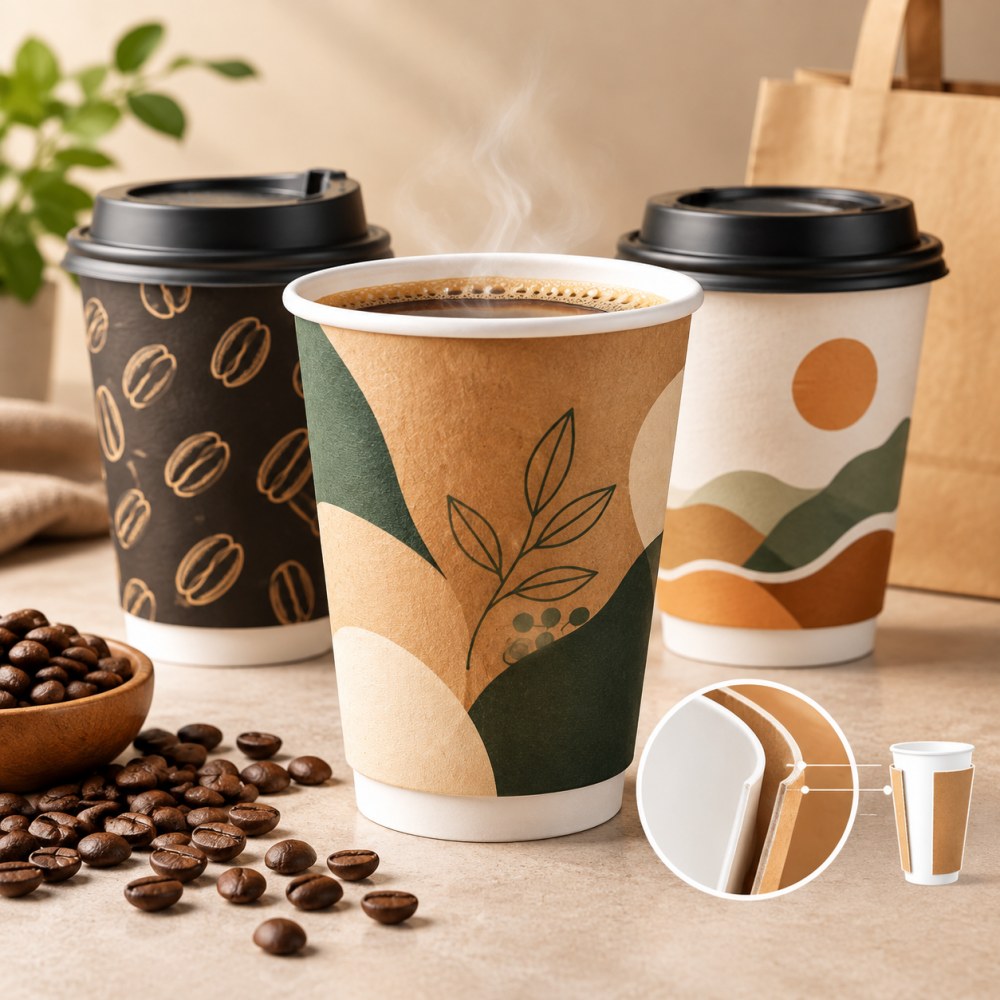
    Hot beverage delivery creates a packaging challenge that coffee shops, cafés, restaurants, catering companies, and food delivery brands must solve every day: how can a cup keep a drink comfortable to hold while maintaining a professional presentation during transportation? Double wall paper coffee cups are designed specifically for this type of application. Their two-layer construction creates an insulating air space between the inner cup and outer layer, helping reduce heat transfer to the consumer's hand while providing a stronger structure for takeaway and delivery service. For wholesale buyers and foodservice packaging distributors, choosing the right double wall cup can improve customer experience, simplify hot beverage delivery, strengthen brand presentation, and support customized packaging programs.   What Is a Double Wall Paper Coffee Cup? A double wall paper coffee cup consists of an inner paper cup combined with an additional outer paper layer. Unlike a conventional single wall cup, the second layer provides additional insulation and structural support. The space between the layers helps reduce direct heat transfer from the beverage to the outside surface. This construction makes double wall cups particularly suitable for coffee, tea, hot chocolate, lattes, cappuccinos, and other hot takeaway beverages. The design is also useful when drinks need to travel from a café or restaurant to a customer's home, office, hotel, event, or workplace. Elements Cup describes its double wall paper cups as food-grade, insulated products that support custom design. Its product range includes different sizes, materials, linings, colors, logos, and packaging configurations for wholesale and customized orders. For businesses looking for a dedicated product range, the double wall paper cups category provides a useful starting point for comparing available styles.   Custom printed double wall paper coffee cups can combine insulation with strong brand visibility.   Why Are Double Wall Cups Better for Hot Beverage Delivery? Hot beverage delivery is different from traditional in-store coffee service. When a customer receives a drink at a café counter, the cup may only need to be carried for a few minutes. Delivery creates a longer handling period and introduces movement, temperature changes, stacking, and transportation conditions. A double wall paper cup addresses several of these challenges at the packaging level. Better hand comfort: The outer wall reduces the amount of heat transferred to the consumer's hand. Improved insulation: The additional layer helps slow heat transfer from the beverage to the external surface. Stronger structure: Two paper layers can create a more rigid cup than a basic single wall construction. Better delivery experience: A sturdy cup can feel more secure when customers receive hot drinks away from the café. Premium appearance: The outer wall creates additional opportunities for high-quality branding and printing. Reduced accessory dependence: In some applications, the integrated outer wall can provide insulation without requiring a separate sleeve. These advantages are especially relevant for coffee brands that depend on takeaway and delivery orders. The cup becomes more than a container; it becomes part of the customer's overall experience with the brand.   Double Wall vs. Single Wall Paper Coffee Cups Single wall paper cups are commonly selected when cost and basic beverage containment are the primary considerations. However, hot drinks can make the external surface of a single wall cup uncomfortable to hold without an additional sleeve. Double wall cups introduce another layer of paper, creating a more insulated structure. This makes them a strong option for hot beverage delivery where hand comfort, rigidity, and presentation are important. Single wall: Lightweight, simple, and often suitable for basic beverage service. Double wall: Better insulation, stronger structure, and a premium takeaway appearance. Ripple wall: Uses a textured outer structure to create insulation and a distinctive tactile appearance. Embossed double wall: Combines double-layer construction with an embossed outer surface for additional texture and grip. The best choice depends on the beverage temperature, delivery distance, brand positioning, packaging budget, and customer expectations.   How Double Wall Construction Improves Hand Comfort One of the most important benefits of a double wall paper coffee cup is improved hand comfort. A hot beverage transfers thermal energy through the inner paper wall toward the outside of the cup. Adding a second wall creates another barrier between the hot liquid and the consumer's hand. This does not mean that the outer surface will remain completely cool. Rather, the additional layer helps reduce the rate and amount of heat reaching the outside surface, making the cup more comfortable to hold during normal use. For delivery businesses, this matters because customers may pick up the beverage immediately after receiving it. A cup that feels too hot can negatively affect the perceived quality of the product, even when the coffee itself is excellent.   Better Protection During Coffee Delivery Delivery packaging needs to handle more movement than an in-store beverage. Cups may be placed inside paper bags, drink carriers, delivery boxes, or insulated bags. They can experience vibration and minor impacts while being transported by car, bicycle, motorcycle, or courier. A rigid double wall structure can provide greater stability during handling. The outer layer adds material around the cup body, which can help the cup maintain its shape when customers grip it or when several drinks are packed together. For commercial buyers, however, cup construction should always be evaluated together with lid fit, rim quality, sealing performance, carton packing, and delivery carrier compatibility. A strong cup alone cannot compensate for an unsuitable lid or poorly designed delivery packaging.   Custom Printing Makes Double Wall Cups a Branding Tool Hot beverage delivery gives brands fewer opportunities to communicate directly with customers than an in-store experience. A customized coffee cup can therefore become an important mobile branding surface. Double wall paper cups offer a relatively large printable exterior area. Coffee shops can use this space for logos, brand colors, slogans, seasonal artwork, QR codes, social media information, or promotional messages. For wholesale and private label buyers, customized printing can also help create a consistent packaging system across multiple beverage sizes. Instead of using generic disposable cups, a brand can develop a recognizable visual identity that appears across delivery orders, takeaway counters, events, and catering services.   Full-color custom printing helps takeaway coffee brands turn disposable cups into mobile marketing assets.   What Sizes Are Available for Hot Beverage Delivery? Cup size should be selected according to the beverage menu rather than choosing a size simply because it is popular. A coffee shop may need several capacities for espresso-based drinks, regular coffee, tea, hot chocolate, and specialty beverages. Elements Cup's custom double wall hot cup specification lists sizes including 7 oz, 8 oz, 8 oz squat, 10 oz squat, 12 oz, 16 oz, 16 oz squat, and 20 oz. This range allows buyers to develop packaging for different menu categories and serving volumes. For example, an 8 oz cup can work well for smaller hot beverages, while 12 oz and 16 oz sizes are commonly useful for standard takeaway coffee programs. Larger sizes can support bigger specialty drinks or extra-volume beverage menus. Before ordering in bulk, buyers should test the selected cup with the actual beverage recipe, lid, carrier, and delivery bag to ensure the complete packaging system works together.   Choose the Right Paper and Inner Lining The paper structure is only one part of a commercial coffee cup. The inner lining also plays an important role because it helps the cup resist moisture and prevents the beverage from penetrating the paper structure. Depending on the product specification and market requirements, buyers may consider conventional PE lining, PLA lining, or aqueous barrier coating. Each option should be evaluated according to performance requirements, environmental claims, local regulations, disposal infrastructure, and certification needs. Elements Cup lists bamboo fiber, kraft paper, and plain white paper as material options for its double wall hot cups, with PE, PLA, and aqueous barrier options available for the lining. The company also lists customization of size, color, logo, lining, and packaging. For buyers prioritizing alternative coating solutions, a dedicated compostable PLA cup range can be considered as part of a broader sustainable packaging strategy.   Double Wall Cups and Sustainable Packaging Sustainability is increasingly important for foodservice packaging buyers, but environmental claims should always be evaluated carefully. A paper cup is not automatically compostable or recyclable simply because its main structure is made from paper. The coating, adhesives, printing inks, packaging configuration, local waste infrastructure, and applicable certification standards can all affect the end-of-life pathway. For example, Elements Cup offers different barrier coating choices, including PLA and water-based aqueous coatings. Its product information notes that PLA and aqueous barrier options can support different compostability pathways depending on the specific product and applicable conditions. For B2B buyers, the most reliable approach is to ask the manufacturer for the exact material specification and relevant certification for the product being ordered, rather than relying on broad terms such as “eco-friendly” or “biodegradable.”   Why Double Wall Cups Work Well for Coffee Shops and Delivery Brands For coffee shops, cafés, bakeries, restaurants, hotels, catering companies, and beverage delivery platforms, double wall cups can provide several business benefits at the same time. Improved customer comfort: Customers can handle hot drinks more comfortably. Professional presentation: A well-designed cup can reinforce the quality of the beverage. Brand visibility: Custom printing keeps the brand visible during takeaway and delivery. Operational simplicity: An integrated double wall may reduce the need for separate cup sleeves in suitable applications. Product differentiation: Custom sizes, colors, printing, and coatings help brands develop a more distinctive packaging system. Wholesale scalability: Standardized specifications make it easier to plan recurring bulk orders.   Branded double wall cups can create a clean and recognizable appearance for takeaway coffee programs.   When Should You Choose Ripple Wall or Embossed Wall Cups? Double wall construction is not the only way to improve insulation and handling. Ripple wall and embossed wall cups can provide different combinations of grip, texture, insulation, and visual appeal. Ripple wall cups use a textured outer layer that creates air pockets and gives the cup a distinctive tactile surface. They can be particularly attractive for cafés that want a more premium or handcrafted appearance. Embossed double wall cups can provide a similar combination of insulation and texture while creating additional opportunities for visual differentiation. They may be worth considering when the packaging itself is part of a brand's design strategy. For businesses comparing these structures, Elements Cup's paper cup collection includes double wall, ripple wall, embossed wall, single wall, and other paper cup solutions.   How to Select Double Wall Coffee Cups for Wholesale Ordering Wholesale buyers should evaluate more than the unit price when selecting a cup supplier. A lower initial quotation may not provide the best total value if the product has inconsistent dimensions, poor printing quality, weak carton packing, or unreliable delivery times. Key questions to ask your paper cup manufacturer: What cup sizes and capacities are available? Which paper materials can be used? What coating options are available? Can the cup be fully customized with a brand logo? What printing method and color specifications are supported? What is the minimum order quantity? Can the supplier provide pre-production samples? What certifications are available for the selected material? How are cups packed for international shipping? Can the manufacturer provide matching lids and beverage accessories? Elements Cup's published double wall cup specification lists an MOQ of 50,000 pieces, a stated lead time of approximately 30 days, and customization for size, color, logo, lining, and packaging. Actual commercial terms should be confirmed with the supplier based on the final specification and order requirements.   Pair Double Wall Coffee Cups With the Right Lids A cup and lid should be treated as one packaging system. During hot beverage delivery, the lid needs to fit securely, resist spills, and match the cup rim accurately. An unsuitable lid can create leakage problems even when the cup itself performs well. For coffee delivery programs, buyers should test the complete combination of cup, lid, beverage temperature, carrier, and delivery bag before committing to a large production order. Elements Cup also supplies cup accessories, including lids, cup holders, sleeves, and straws, allowing buyers to source complementary foodservice packaging from the same supplier.   How Double Wall Paper Cups Support a Better Delivery Experience The success of hot beverage delivery depends on more than keeping coffee inside a container. Customers notice whether the cup feels comfortable, whether the lid stays secure, whether the packaging looks professional, and whether the beverage arrives in a condition that matches their expectations. Double wall paper coffee cups address several of these requirements through their structure. The additional paper layer helps provide insulation, rigidity, and a larger surface for customized branding. Combined with the correct lid and delivery carrier, they can form a practical packaging solution for modern takeaway and delivery businesses. For brands that serve large volumes of coffee and other hot beverages, selecting the right cup construction at the beginning can also make procurement more consistent. Standardized sizes, materials, printing specifications, and packaging configurations can simplify repeat purchasing as the business grows.   Final Thoughts for Wholesale Buyers Double wall paper coffee cups are a strong option for hot beverage delivery because they combine insulation, structural strength, consumer comfort, and branding potential in one packaging format. They are especially useful for coffee shops, cafés, restaurants, catering companies, foodservice distributors, and beverage brands that depend on takeaway and delivery sales. When selecting a supplier, look beyond the appearance of the cup. Evaluate the paper material, inner coating, cup size, printing quality, lid compatibility, certifications, MOQ, production capacity, packaging, and export experience. Looking for custom double wall paper coffee cups for your beverage business? Start by defining your cup size, beverage type, printing requirements, coating preference, lid specification, and expected order volume. Then request samples and test the complete packaging system under real delivery conditions. With the right specification and a reliable manufacturing partner, custom double wall paper cups can help your business deliver hot beverages more comfortably while turning every takeaway order into an opportunity for stronger brand recognition.  
leave a message

leave a message
If you are interested in our products and want to know more details,please leave a message here,we will reply you as soon as we can.
Submit

Home

Products

whatsApp

contact