The Advantages of Double Wall Paper Cups for Delivering Hot Coffee
Nov 23, 2026If your coffee program sends drinks out by scooter or courier, the cup is the part of the order you can no longer fix at the customer's door. A 12oz latte leaves the bar at 88–92°C. By the time it reaches the third floor it is closer to 60°C, and a good share of that drop happens straight through the cup wall. Double wall construction exists for that gap. At Elements Cup we produce these cups for café chains, convenience store programs and distributors, so the notes below come from sampling rooms and lid tests.
Quick answer: a double wall paper coffee cup is a normal cup with a second paper layer wrapped around the body, leaving a 3–5 mm air gap. With a 90°C drink inside, the outer wall usually sits between 38°C and 44°C (100–112°F). The drink holds its heat longer, the customer can carry the cup without a sleeve, and the body stays stiff once it is packed beside four other drinks.
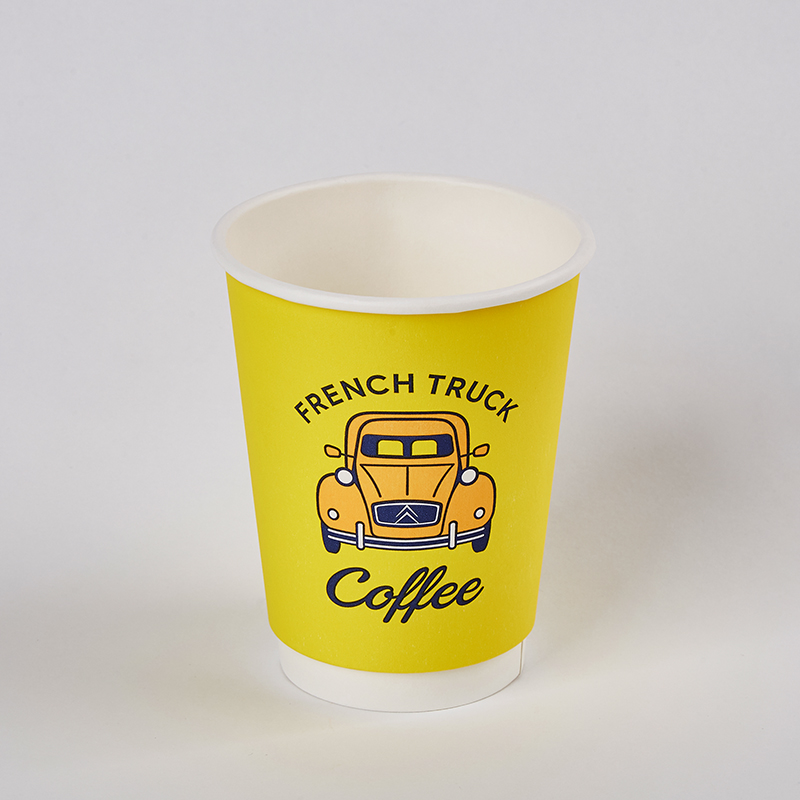
A 12oz double wall cup, full-wrap print. The outer wall carries the artwork.
A single wall cup is 250–300 gsm board with a thin lining. Heat crosses it quickly, so the cup turns uncomfortable within minutes. Add a second board layer and you get a still air gap instead. Still air is the cheapest insulator available.
The effect is real but modest. In our fill tests with 90°C water, the outside of a 12oz double wall paper cups reads roughly 20–25°C cooler than the same size in single wall. That changes how the cup feels in a hand, not how long the coffee stays hot. Treat it as a 15–30 minute improvement, not thermos performance.
Drivers stack cups, wedge them against thermal bags and lean the load on a door frame. A single wall cup deforms and the lid lifts. The bonded outer layer adds hoop strength, so the body keeps its shape and the lid stays seated. Textured surfaces such as ripple wall paper cups add another layer of crush resistance where bags get crowded.
The body is rarely what breaks first. Rim crush is: anything heavy resting on the top rim opens the lid seal. A carrier or a taller carton fixes that. A thicker cup does not.
Hot liquid plus cold air means condensation, and it usually forms on the lid and the exposed rim rather than the body. The double wall keeps that moisture off the customer's hand, but it does not stop water collecting in the lid groove.
The side seam and bottom are glued, and heat plus steam softens that glue. Two habits prevent most failures: leave 8–10 mm of headspace so the lid never sits in liquid, and keep the drink out of a sealed bag for much more than 30 minutes. If deliveries run longer, test at that length before committing to a container order.
More leaks come from a mismatched lid than from a bad cup. Rim diameter tolerance varies between suppliers by a millimetre or two, which is enough for a lid that clicks on in the sample room to pop off in a bag. Order cups and paper cup lids from one source, or send your lids to the factory so the fit can be checked on the actual tooling.
The acceptance test takes ten minutes. Fill at 90°C, press the lid on, tilt the cup 45 degrees and hold for 30 seconds. Repeat after twenty minutes, because warm board behaves differently from cold board.
The outer wall is a large, clean print surface, which is much of the appeal for takeaway brands. Full-wrap artwork, QR codes and seasonal campaigns all work here. What matters commercially is how the print behaves after rubbing against other cups for half an hour.
Two rules. Keep large solid colour areas away from the base and the rim, since those contact points scuff first. Choose matte or semi-matte varnish for busy delivery programs, because high gloss shows scratching sooner. Our custom printed double wall cups use food-grade inks with a water-based varnish.

Full-wrap print turns a disposable cup into a moving billboard.
Delivery orders skew larger than in-store orders, but not as much as people assume. A workable mix is 60% in 12oz and 16oz, 30% in 8oz, 10% in 20oz. Squat sizes share a wider rim and need their own lid SKU, and every extra size adds a carton.
| Size | Typical drink | Delivery note |
|---|---|---|
| 8oz | Flat white, small latte, tea | Strong office-breakfast seller |
| 8oz squat | Cappuccino | Wide rim, separate lid |
| 12oz | Medium latte | The volume driver in most markets |
| 16oz | Large latte, Americano, tea | Taller, check clearance |
| 20oz | Large tea, long black | Popular in North America |

A 16oz double wall cup. Bigger sizes gain the most from the air gap.
PE is the workhorse: cheapest, easiest to seal, accepted by mills that handle poly-coated board. PLA makes the cup industrially compostable, but shelf life is about eight months and order minimums are higher. Aqueous coatings are PFAS-free and repulpable in normal paper recycling, which is why European and UK tenders increasingly ask for them. If you supply those markets, compare aqueous barrier coating cups with standard PE before locking a price. For compostable programmes, compostable PLA paper cups are the usual starting point.
Ask your waste contractor one question: does the local stream accept coated cups? If not, an aqueous coating on plain board usually causes less confusion than a compostable claim nobody can process.

Unprinted kraft double wall cups for a quieter shelf presence.
Seven checks to run on a sample box.
Custom print usually starts at 50,000 pieces per size, which is realistic for a small chain ordering quarterly. If you need mixed sizes or retail-ready cartons, our custom paper cup service covers artwork proofing, tooling and packing design in one flow.
In most cases, no. The air gap keeps the outer surface in the 38–44°C range at normal serving temperatures, which is comfortable to hold. Drinks above 95°C may still call for one, but at 85–90°C a sleeve becomes an optional extra.
It depends on the lining. PE-coated cups are recyclable wherever mills accept poly-coated board. Aqueous-coated versions repulp in standard paper recycling. Compostable PLA linings need an industrial composting facility and should never go into the paper stream.
Double wall uses a smooth outer layer bonded at the rim and base. Ripple wall uses a corrugated outer layer, so the surface has vertical ridges. Ripple cups feel slightly warmer to hold and resist crushing a little better. Double wall cups print more cleanly and stack more compactly.
Yes. The outer wall accepts full-colour offset or flexo printing, and we can match Pantone references. Custom print generally starts at 50,000 pieces per size and design; below that, stock cups with a printed sleeve or sticker are cheaper.
They work, but they are not the best use of the material. Cold drinks create condensation on the outside, and a double wall traps that moisture between the layers, softening the board over a long delivery. For iced drinks, a cold-drink cup or a clear PET or PLA cup performs better and costs less.
Double wall cups are not complicated packaging, but the details that decide whether they work on delivery are easy to miss: a lid that matches the rim, a fill level that leaves room for steam, a varnish that survives rubbing, and a coating your local waste stream will take. Get those four right and the extra paper pays for itself in fewer remakes and fewer burnt fingers.
If you need samples before your next range review, talk to our team at this paper cup manufacturer and we will send a sample box in your sizes.


No. 15-5 Rongyuan Road Xiamen
© 2026 Xiamen Elements Packaging Co., Ltd. All Rights Reserved